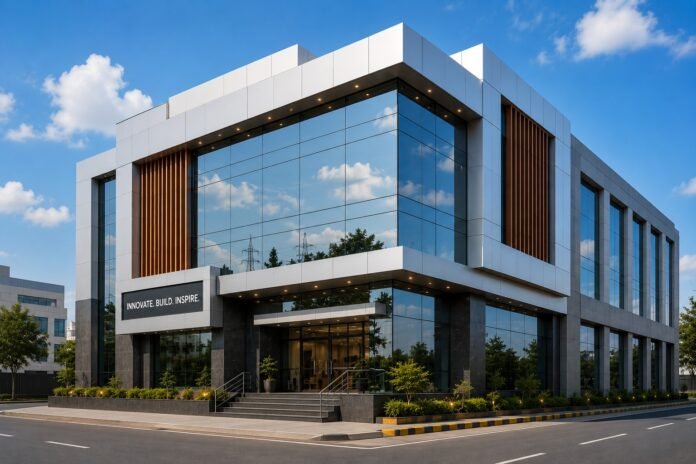
South India’s construction industry is entering a new phase of growth. Rapid urbanisation, expanding IT infrastructure, industrial investment, healthcare development, and government-led infrastructure projects are reshaping how commercial buildings get designed and built. Developers no longer evaluate a building purely on construction cost or structural performance — increasingly, the facade itself has become a critical component that shapes architectural identity, energy efficiency, lifecycle cost, and long-term asset value.
Modern facade technologies, particularly ACP (Aluminium Composite Panel) systems, structural glass glazing, and high-performance aluminium facade systems, are playing a central role in that shift. Across cities such as Bengaluru, Chennai, Hyderabad, Coimbatore, Kochi, Madurai, and Trichy, commercial buildings are increasingly adopting integrated facade solutions that pair aesthetics with genuine engineering performance.
South India’s Construction Market Is Evolving
Over the last decade, South India has seen substantial growth across multiple construction sectors. IT parks, corporate headquarters, hospitals, airports, educational institutions, manufacturing facilities, logistics hubs, shopping malls, and premium commercial complexes are all driving demand for modern architectural exteriors.
Unlike conventional plaster-and-paint finishes, today’s commercial developments are expected to deliver long-term durability, lower maintenance costs, improved energy efficiency, and a contemporary architectural identity. As a result, facade engineering has become an integral part of project planning rather than a finishing activity tacked on at the end of construction.
Industrial Cladding Contractor Continue to Lead Commercial Projects
Aluminium Composite Panel systems remain one of the most widely specified facade materials for commercial construction across South India. Their popularity comes down to a fairly practical combination of lightweight construction, design flexibility, weather resistance, and installation efficiency.
Many commercial developments specify 4 mm exterior-grade ACP panels from recognised manufacturers such as VIVA and Aludecor, with the final material selection depending on project specifications, fire requirements, wind loads, and architectural design intent.
The widespread adoption of ACP facade systems is driven by several practical advantages:
- Lightweight construction with reduced structural loading
- Excellent resistance to heat, humidity, rain, and UV exposure
- Faster installation compared to conventional wall finishes
- Wide availability of colours, textures, and metallic finishes
- Lower maintenance requirements over the building’s lifecycle
- Greater flexibility for contemporary architectural designs
Rather than functioning purely as decorative cladding, modern ACP systems are now built into complete facade engineering strategies that support architectural performance and commercial functionality alike.
Structural Glass Glazing Is Redefining Modern Commercial Architecture
One of the more significant trends shaping South India’s construction industry is the growing adoption of structural glass glazing. Corporate offices, hospitals, hotels, airports, educational institutions, automobile showrooms, and premium retail developments are increasingly combining ACP facade systems with structural glazing to create modern, high-performance building envelopes.
Many commercial projects now specify Double Glazed Units (DGU) using configurations such as 6 mm toughened glass with a 12 mm insulated air space and a further 6 mm toughened glass, often manufactured by internationally recognised companies such as Saint-Gobain, depending on consultant specifications and project requirements.
Combined with thermally broken aluminium framing, these glazing systems deliver several measurable performance benefits:
- Improved thermal insulation
- Lower cooling loads and energy consumption
- Better acoustic performance
- Increased natural daylight
- Enhanced occupant comfort
- Greater operational efficiency
As sustainability standards continue to evolve, structural glazing has become an essential component of high-performance commercial buildings rather than simply a premium architectural feature.
Government and Industrial Projects Are Raising Performance Standards
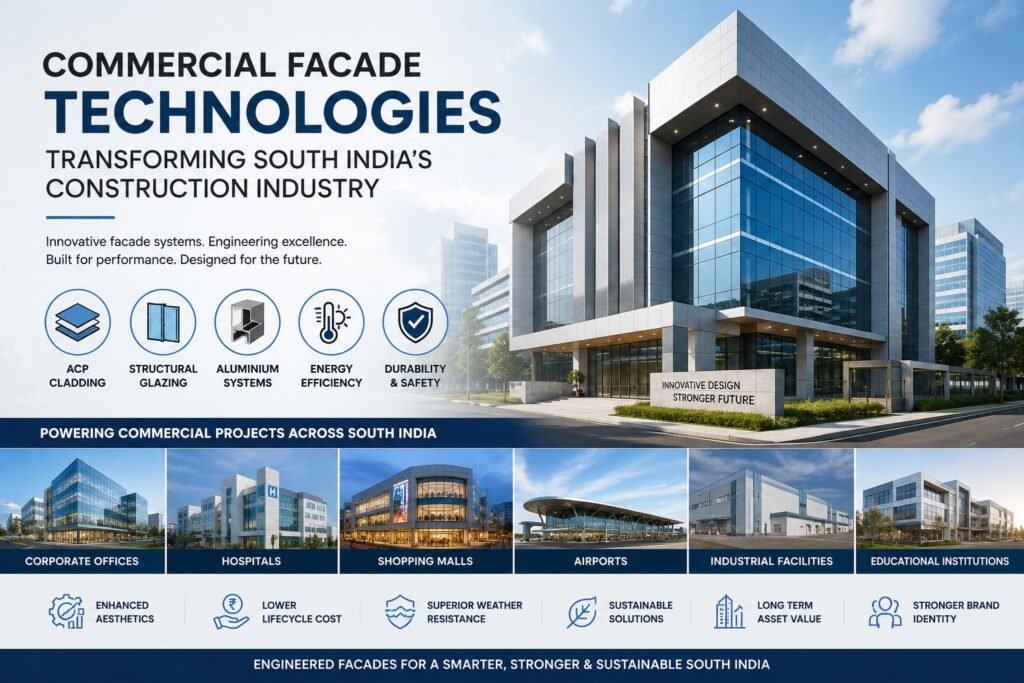
Modern facade technologies are no longer confined to private commercial developments. Government buildings, smart city projects, airports, railway stations, educational campuses, healthcare institutions, and public infrastructure projects are increasingly specifying engineered facade systems designed for durability, fire performance, and reduced maintenance.
Industrial construction is undergoing a similar shift. Manufacturing facilities, pharmaceutical plants, logistics parks, food processing units, and corporate manufacturing campuses are investing in ACP cladding and structural glazing to create facilities that combine operational efficiency with a professional corporate identity.
For these projects, facade systems contribute to more than aesthetics — they also support lifecycle cost reduction, improved building performance, and easier long-term maintenance.
Sustainability Is Driving Material Selection
Environmental performance has become an important consideration across South India’s construction sector. Architects, facade consultants, and developers are increasingly evaluating materials based on lifecycle performance rather than initial construction cost alone.
Modern facade systems support sustainable construction by helping reduce operational energy consumption, improving daylight utilisation, minimising maintenance requirements, and extending the service life of commercial buildings.
The growing adoption of insulated glazing, thermally broken aluminium framing, recyclable aluminium systems, and durable exterior-grade ACP panels reflects a broader industry shift toward environmentally responsible construction practices.
Technology Is Changing How Facades Are Delivered
Advances in digital design, Building Information Modelling (BIM), CNC fabrication, precision manufacturing, and modern installation techniques have meaningfully improved facade quality and project efficiency.
Today’s commercial facade projects involve close collaboration between architects, structural consultants, facade engineers, fabricators, and installation specialists from the earliest stages of project planning. This integrated approach improves coordination, reduces construction delays, enhances installation accuracy, and supports better long-term building performance.
As construction projects grow more complex, professionally engineered facade systems are becoming a standard requirement rather than an optional upgrade.
The Future of South India’s Facade Industry
The future of South India’s commercial construction industry is likely to be shaped by integrated facade technologies that combine ACP systems, structural glass glazing, curtain wall systems, architectural aluminium, and energy-efficient building envelopes.
With continued investment in IT infrastructure, healthcare, manufacturing, logistics, hospitality, education, and government development programmes, demand for high-performance facade systems is expected to keep growing across both metropolitan and emerging Tier-2 cities.
Developers are increasingly recognising that modern facade systems contribute far beyond architectural appearance. They support operational efficiency, enhance brand identity, improve occupant comfort, strengthen sustainability performance, and increase long-term commercial value.
Delivering the Next Generation of Commercial Facades
As facade technology continues to evolve, successful commercial projects depend on much more than selecting premium materials. Long-term performance requires careful engineering, precise fabrication, quality installation, and close coordination between architects, structural consultants, facade engineers, and construction teams throughout the project lifecycle.
Companies such as Galaxy Graphics & LED are contributing to this transformation by supporting commercial developers, architects, EPC contractors, industrial clients, and institutional projects across Tamil Nadu and South India with integrated ACP facade contracting, structural glass glazing, and complete commercial exterior solutions designed for long-term building performance.
About the Author
Ahmad Mydeen is the Founder of Galaxy Graphics & LED, specialising in ACP facade contracting, structural glass glazing, aluminium facade systems, and commercial exterior solutions across Tamil Nadu and South India. He works with architects, developers, EPC contractors, government agencies, hospitals, factories, educational institutions, and commercial property owners to deliver high-performance facade systems that combine engineering excellence with long-term commercial value.