By Sunny Banerjee
There is a growing sense that many contemporary homes, despite their refinement, are missing something essential. They are carefully designed, visually resolved, and materially rich, yet once inhabited, they often reveal a quiet limitation: they do not change.
Surfaces remain as they were arranged. Light performs its intended role but does not evolve. The space, however well composed, settles into predictability. For occupants navigating increasingly fast-paced and digitally saturated lives, this static quality can feel less like calm and more like absence.
What is emerging across India’s metropolitan homes is a response to this condition—not in the form of a stylistic trend, but as a shift in how interiors are fundamentally understood. A growing number of spaces are beginning to incorporate living ecosystems, introducing a dimension that traditional design has largely excluded: behaviour over time.
This shift is subtle in appearance but significant in impact. It moves the home away from being a fixed composition of objects toward becoming an environment that evolves, responds, and sustains engagement.
The distinction becomes clear when one considers how conventional interiors are experienced. They are designed to achieve a moment of visual clarity. Once that moment is reached, the space is effectively complete. It offers little variation beyond what has already been composed.
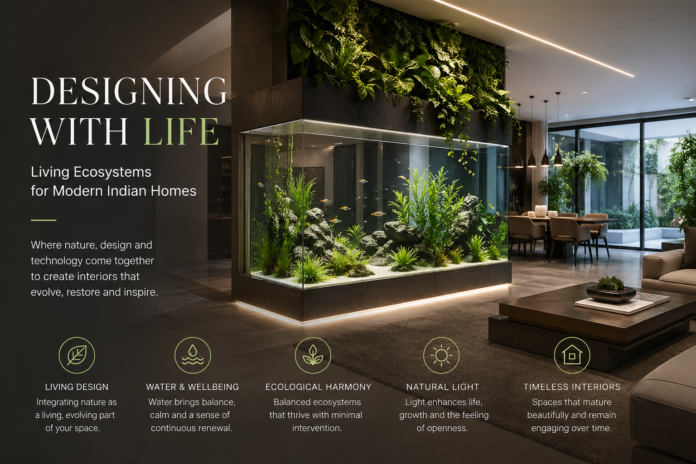
Living ecosystems operate differently. By integrating water, plant life, and biological processes into the structure of the space, they introduce continuous, controlled variation. Light interacts with growth, influencing colour and density. Water refracts and shifts, altering depth and reflection. Plants respond to their environment, adapting in ways that are gradual but perceptible over time.
The result is not visual excess, but continuity.
A space that incorporates such systems does not reveal itself all at once. It unfolds. The eye returns to it not because it demands attention, but because it offers subtle change without disruption. This creates a form of engagement that is quieter and more sustainable than the immediate impact of static design.
Among the elements that enable this transformation, water plays a particularly important role. Unlike solid materials, which assert stability, water introduces movement. It softens edges, alters reflections, and creates patterns that are never identical from one moment to the next. These qualities affect not only how a space looks, but how it is perceived. Visual processing slows, and attention lingers.
Light, in this context, becomes more than illumination. It interacts with the system, shaping both biological behaviour and spatial perception. Its role extends beyond highlighting surfaces to influencing how the environment evolves.
Together, these elements recalibrate the experience of the interior. They create spaces that are not static backdrops, but active environments—spaces that support a different pace of engagement.
This approach is closely aligned with broader principles of Biophilic Design, which emphasise the integration of natural processes into built environments. However, what distinguishes the current movement is its depth of execution. It is not limited to the visual presence of nature, but extends to the functioning of ecological systems within the space.
This introduces a layer of complexity that cannot be addressed through aesthetics alone. A living ecosystem must be designed to operate. It requires an understanding of how light, nutrients, water chemistry, and biological load interact. These relationships determine whether the system stabilises or deteriorates over time.
In India, these challenges are amplified by environmental conditions. Across metropolitan regions—Mumbai, Bengaluru, Hyderabad, Chennai, Delhi—homes operate within constraints that demand careful calibration. Water quality varies, often affecting biological balance. Temperature fluctuations introduce additional stress. Urban environments, increasingly sealed, limit natural buffers.
Under such conditions, integrating living systems into interiors is not simply a matter of placement. It requires precision.
This has led to the emergence of a more technically grounded approach to design, where systems are engineered rather than assembled. Practices working in this space, including firms such as ProHobby New Delhi (https://prohobby.in), approach aquatic and hybrid environments as structured ecosystems—designed to maintain stability over time rather than deliver short-term visual impact.
The distinction is significant. It marks the difference between installations that decline and those that mature.
As this approach gains traction, it is beginning to influence how value is perceived within the home. Traditional notions of luxury have relied on immediacy—materials and compositions that impress upon first encounter. Living ecosystems offer something different. Their value unfolds gradually, through sustained interaction.
They reward attention over time rather than capturing it instantly.
This aligns with a broader cultural shift toward environments that prioritise experience over display. The home is no longer seen solely as a space to be presented, but as one to be lived in—an environment that supports both activity and restoration.
Living ecosystems contribute to this by introducing continuity into the space. They create conditions that change gently, maintaining engagement without overwhelming it. In doing so, they address a challenge that has become increasingly relevant: how to design interiors that feel calm without feeling empty.
It would be reductive to view this development as a passing trend. What is taking shape is a redefinition of the interior itself.
If this trajectory continues, the homes that define the coming decade will not be those that achieve the highest level of visual perfection, but those that sustain a sense of balance. They will be spaces that evolve without losing coherence, that respond without becoming unstable.
Spaces, in other words, that are not simply designed, but lived as systems.
Author Bio
Sunny Banerjee is associated with ProHobby™, an ecological systems design practice based in Delhi and operating across India’s metropolitan regions. The firm specialises in aquatic and hybrid living environments that integrate biological stability with contemporary interior architecture.