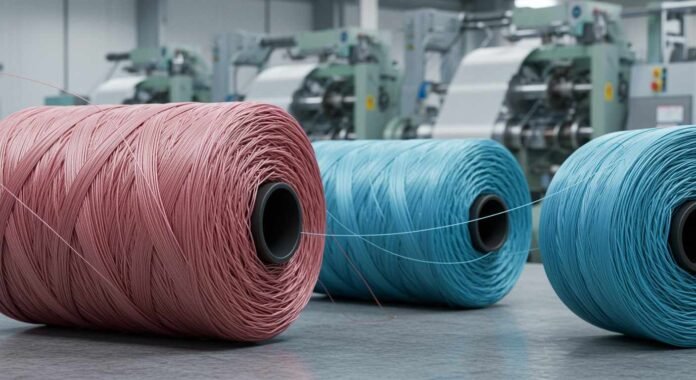
A single strand of fiber, barely visible to the naked eye, often holds the weight of massive industrial operations. While multi-filament threads are common in fashion, the world of heavy-duty filtration, agriculture, and high-precision screening relies on the structural integrity of Monofilament Yarn. Unlike spun yarns that consist of many tiny fibers twisted together, a monofilament is a single, continuous solid strand. This unique construction provides a level of uniformity and chemical resistance that is impossible to achieve with blended fibers, making it the preferred choice for engineers who demand absolute predictability in their materials.
The Engineering Behind the Strand
The creation of a high-quality monofilament is a masterclass in polymer science. It begins with high-purity resin chips—typically Nylon, Polyester, or Polypropylene—which are melted and extruded through a circular die. The speed at which the fiber is drawn and cooled determines its final diameter, tensile strength, and elasticity.
When sourcing from a top-tier Monofilament Yarn manufacturer, you are paying for consistency. In industrial applications, a variation of even a few microns in the diameter can lead to a catastrophic failure in a filtration mesh or a commercial fishing net. High-end manufacturers utilize laser-controlled monitoring systems to ensure that every kilometer of yarn produced meets exact technical specifications.
Versatile Applications Across Major Sectors
The utility of these single-strand fibers is staggering. Because they have a smooth, non-porous surface, they are inherently resistant to mold, bacteria, and moisture absorption. This makes them indispensable in several key areas:
- Industrial Filtration: Used in the chemical and pharmaceutical industries to create precision meshes that can filter out microscopic particulates while resisting corrosive solvents.
- Agriculture and Greenhouse Tech: Employed in the creation of durable shade nets, anti-hail nettings, and crop support systems that must endure years of intense UV exposure.
- Aquaculture: High-tenacity yarns are braided into massive sea cages and commercial fishing lines that must withstand the brutal mechanical stress of ocean currents.
- Automotive and Aerospace: Used as protective braiding for wire harnesses, providing a lightweight yet incredibly tough barrier against heat and abrasion.
According to Forbes, the shift toward sustainable and high-durability materials is driving massive innovation in the synthetic fiber market. This evolution is pushing a leading Monofilament Yarn manufacturer to develop bio-polymers and recycled resins that offer the same performance as traditional petroleum-based plastics but with a significantly lower carbon footprint.
Why Quality Control is the Ultimate Differentiator
In the competitive landscape of industrial textiles, not all fibers are created equal. The “breaking strength” and “elongation at break” are two metrics that define the lifespan of a product. If a yarn is cooled too quickly during production, it becomes brittle; if it is drawn too slowly, it loses its structural memory.
Professional-grade Monofilament Yarn undergoes rigorous testing for UV stabilization and thermal shrinkage. For outdoor applications, such as fencing or shade cloth, the addition of high-grade UV stabilizers is non-negotiable. Without this chemical protection, the sun’s radiation would break the molecular bonds of the polymer, leading to “ghosting” or sudden snapping within months of installation.
Scaling Efficiency with Specialized Solutions
For businesses, the choice of yarn impacts the bottom line through machine efficiency. Low-quality yarns often carry “slubs” or surface irregularities that can snag in high-speed weaving looms, causing expensive downtime. By choosing a partner that prioritizes surface smoothness and spooling consistency, manufacturers can run their machines at higher speeds with fewer interruptions.
Modern innovations have also introduced “dope-dyed” monofilaments. In this process, the color pigment is added directly into the molten polymer before extrusion. This results in a strand where the color is integrated throughout the fiber, making it virtually immune to fading, bleaching, or washing out—a critical requirement for safety equipment and high-visibility industrial nettings.
Investing in Reliability and Strength
In the world of industrial manufacturing, the smallest components often carry the greatest responsibility. A single-strand fiber might seem simple, but the science required to make it durable, consistent, and chemically resistant is anything but. Whether you are building massive offshore aquaculture systems or precision medical filters, the quality of your base material dictates the success of your final product.